

|
|
|
||
|
||||
|
||||
|
|
|
|
|
|
 |
|||||
 |
|||||
 |
|||||
 |
|||||
|
|
|
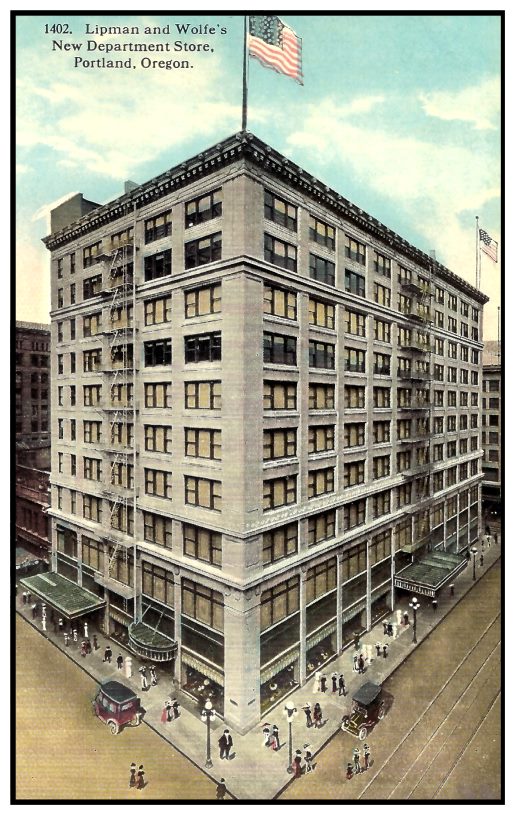
The beginnings of Lipman Wolfe & Co. go back to 1850 in Sacramento when gold fever had a grip on everyone. Adolphe Wolfe, who was originally from Germany, had immigrated to America many years before and teamed with his uncle Solomon Lipman, to become successful merchants. Wolfe opened a branch of the family store in Virginia City, Nevada to capitalize on the wealth of the Comstock Lode Silver Mines. As the luster of the Silver Mines began to fade, Wolfe decided to try his luck elsewhere and he moved to Portland in February 1880. When Wolfe arrived, the cold rain was coming down in sheets and after spending a few years in Nevada, it was quite a shocking experience. Had it not been for the friendly welcome from Portland leaders William Ladd, Henry Corbett and Henry Failing, Wolfe later said he probably would have left on the next boat out. Wolfe set up shop in a building at Washington and First streets where Portland’s first store elevator transported patron’s vertically. His customers marvelled at being able to move among the other floors without using stairs. Following the lead of fellow merchant Henry Corbett, Lipman & Wolfe Company closed the store on Sundays. Wolfe also introduced several revolutionary ideas of his own. He marked the prices of his items in plain numerals, in full view, not using the code fashion of the time. There was no haggling, items were sold at the marked price. Lipman & Wolfe also started the practice of making change down to the penny, instead of down to the last nickel, as was the custom of the day. This forced the Ladd & Tilton Bank to telegraph for supplies of copper pennies, which prior to this time were not readily available. Until the coppers arrived, Lipman Wolfe & Co. made change with postage stamps. Wolfe moved his store two blocks up Washington to the grand new Dekum Building at Third Street, but that wasn’t far enough to spare him from the great flood of 1894. By 1912, Lipmans had moved uptown to its own huge building at Fifth & Washington, which was located across the street from the north end of Meier & Frank. Architect A.E. Doyle, who also designed the U.S. Bank Building, the Central Library, Reed College, Multnomah Falls Lodge and Meier & Frank, was the architect on the Lipman Wolfe Building. Buying offices were opened in London, Paris and Berlin. The Oregon Journal announced that Lipman & Wolfe displayed gowns within 12 days after they appeared on the boulevards of Paris. During World War I, the entire eighth floor was turned over to the Red Cross. Wolfe died in 1933, several years after management of the store was passed on to his nephew, Harold Wendel. |
|
|
 |
|
|
|
|
|
|
 |
|
|
|
|
|
|
|
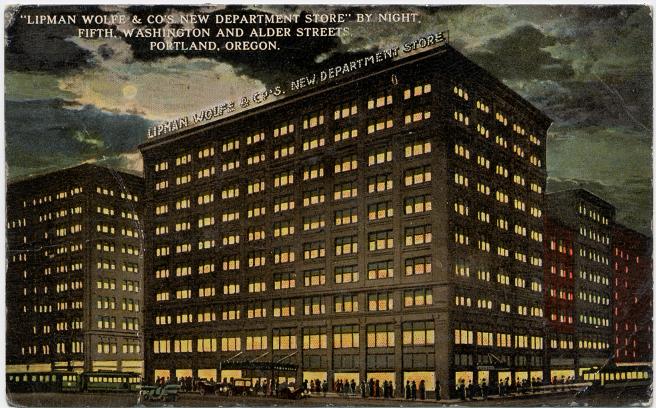
Night sales were popular as evidenced by this view from about 1920. |
|||||
 |
|||||
|
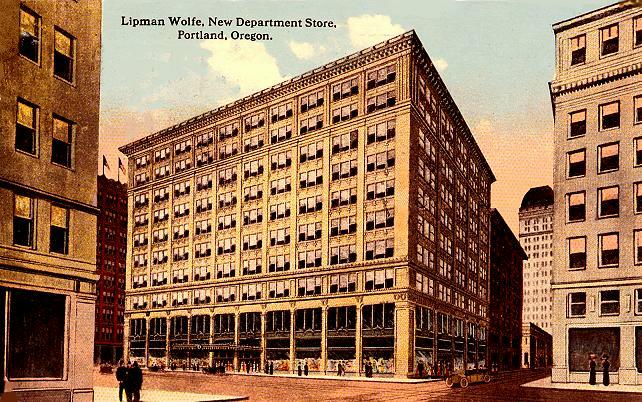
Northeastern perspective of Lipman & Wolfe Co. circa 1912. |
|||||
|
|
|
In 1956, the Bill Roberts and his brother Richard of Roberts Brothers Department Store bought Lipman Wolfe & Co. stores in Oregon and then Diamond’s stores in Arizona. They did a top-to-bottom renovation of Lipman's downtown store, and overhauled its image, too. They emphasized quality and elegance, and found a marketing niche of shoppers who appreciated that in a store. One of the chief reasons they succeeded, Roberts said years later in an interview with The Oregonian, was that Lipman's, like Meier & Frank at the time, had a family commitment behind its operation. ''Most department stores across the country have been purchased by very large chains. Then they start to run them by the book,'' Roberts said. The Lipman's-Roberts Bros. stores were merged with the Dayton Corp. of Minneapolis in 1968 in a stock transaction valued at $33.3 million. Then in 1979, Marshall Field’s bought all six Lipman’s Stores and made them Frederick & Nelson stores. |
|
|
|
|
|
|
|
|
|
|
John Slocum, who worked for three summers in the Chocolate Lounge in the late 1950s, recalls making “Tiger Tigers” (orange ice cream with chocolate swirl syrup in a parfait glass) and “Idiot’s Delight,” several scoops of ice cream of all flavors topped with a sample of all the toppings, including strawberries, chocolate syrup, marshmallows and nuts, etc. in a large bowl. Also, Brian Thompson, who began working at Lipmans in June 1972 recalls, “the restaurant on the mezzanine had recently been renamed the “Orange Slice” and many regulars still called it the Chocolate Lounge. The manager was a friendly woman named Audrey Snider, and many of the employees and regulars called her Miss Audrey, even though she was married. She was just fine with being called Audrey, too. I started as a dishwasher, then I became a busboy and a "soda jerk", turning out fountain items like Root Beer Floats and Lime Freezes. The manager of the store's restaurant services was Irene Sleightam, and she personally managed the 8th floor tearoom. We were encouraged to call her Miss Irene. Another restaurant, The Noon Whistle, opened in 1974 and I was selected to be its manager. It was a small cafe on the 7th floor, next to the Juniors Department, on the south end of the floor. We had a small menu of sandwiches, ice cream and beverages, and we wore a striped overall uniform over a white T-shirt. I was a substitute Cinnamon Bear and don't remember doing it more than maybe three times. The store brought out Santa Claus and the Cinnamon Bear only for the period between Thanksgiving and Christmas. John Hillsbury, a local Portland actor, was Santa Claus for many years and had a huge following. He had a knack for remembering kids' names and they were always so thrilled when he'd call them by name from previous years' visits. The Cinnamon Bear was usually my friend Richard Schaeffer, who in non-holiday periods did a lot of carpentry and window display work around the store. I only filled in when Richard couldn't be there. Richard and John are both deceased as far as I know. I remember one Cinnamon Bear experience in particular, and it was a "special" appearance at the Washington Square store on a very hot summer day for some sort of promotion. I wore the huge, heavy, and hot bear suit and walked around the store handing out cinnamon cookies to kids. At one point, I got so hot I needed to dive under a "rounder" of clothes and take the head off, just to get some air. The other times I wore the suit were at the downtown store during winter holidays. I remember Santa and I had our space on the 4th floor, near the young men's department.” When the store was still Lipman’s in the 1960s and 1970s, they had a Lunch Counter on the Mezzanine as well as a Men’s Pub. In the Tearoom they would even serve Dinner Buffets with really good Prime Rib. The Chef’s name was Tweedy and there was a Asian chef. The baker was Joan. In the late 60s, the staff wore white waist coats, black pants and bow ties. I remember eating lunch on the tenth floor Tearoom a couple times a week in the 1980s. Frederick & Nelson had the best service and the best lunch in town. One of my favorite items on the menu was the Montague Sandwich, the bigger brother of the Monte Cristo. The Cinnamon Bear was welcomed at Frederick & Nelson and the tradition continued until Frederick & Nelson went out of business. In 1986, when Frederick & Nelson was sold to Seattle investors, this store and five other Frederick & Nelson stores were shuttered. The only store that remained open in Oregon was at Washington Square. It was closed in 1990 and was subsequently rebuilt as a Nordstrom store. Frederick & Nelson went bankrupt after 101 years in business in 1992. A special word of thanks to John Slocum for sharing his memories of working in the Chocolate Lounge in the late 1950s and Don Walls, now of Spokane, who shared his memories of working at the Tearoom in the 1960s and ‘70s while he was attending Lincoln High School. Thanks also to Brian Thompson who shared his memories of working at Lipmans from 1972 to 1977. |
||||||||
 |
||||||||
 |
||||||||
|
Last updated 09-12-17 |
||||||||
 |
||||||||
|
copyright © 2017 PdxHistory.com |
||||||||