

|
|
|
|
||
| [Portland History] [Site Map] [Amusement Parks] [Oaks Park] [Early Portland] [Department Stores] [Streetcars] [Railroads] [Mt Hood] [Oregon Coast] [Post Card History] [Portland Hotels] [Portland Neighborhoods] [Getaways] [Contact Us] |
|
Amusement Parks in America |
|
|
|
|
|
|
|
|
|
|
 |
|||||||||
 |
|||||||||
|
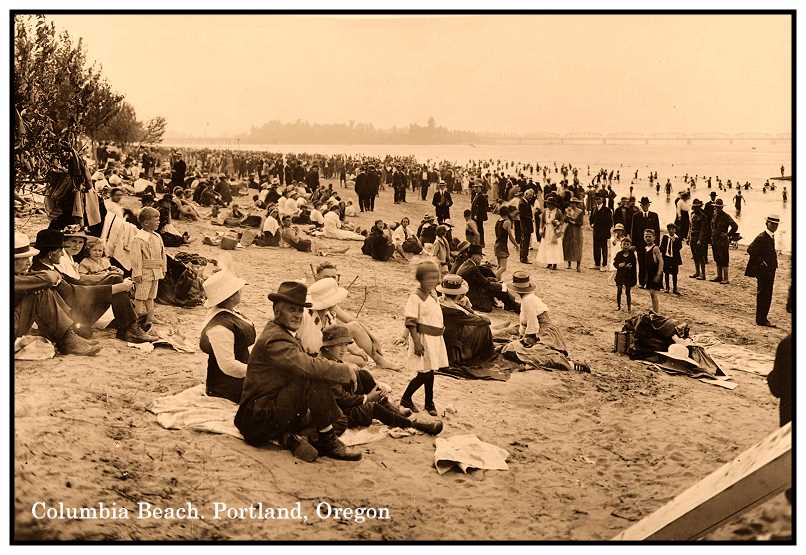
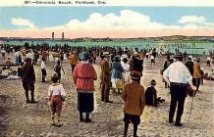
On warm Sunday afternoons during the summer, a crowd of over 15,000 people would be found at Columbia Beach. |
|||||||||
|
Once upon a time, summer was a time for sea bathing, playing croquet, sailing and walking. Life didn’t have the hectic pace that keeps us distracted today. Thousands of people would flock to the beaches in the summers and especially on the weekends. Many people would even seek out Mineral Springs, looking for medicinal benefits. Swimming was much more popular in those days. The average home didn’t have running water, so baths were usually taken out of doors or on a trip to town. Coney Island became an amusement resort, as did many other towns along the ocean shore. It is considered to be the birthplace of the American amusement resort. Several luxury hotels were built there in the 1870s and a ten-mile railroad was extended there from the city. Coney Island was described as “heaven at the end of a subway ride.” They also called it the “Nickel Empire.” Every ride cost 5 cents and so did a hot dog or a pop. |
|||||||||
 |
|||||||||
|
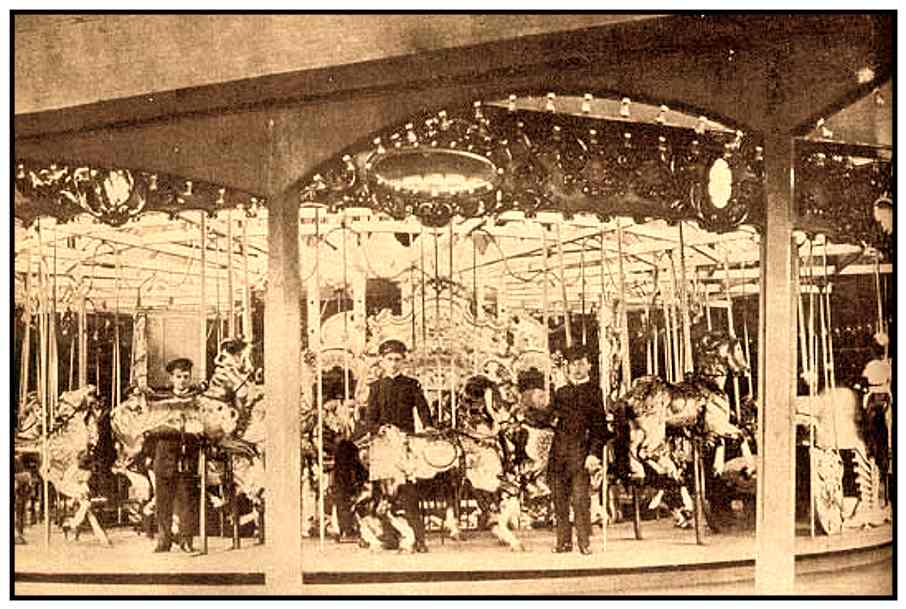
Carry-Us-All with wooden animals carved by Charles Loof in the 1870s. |
|||||||||
|
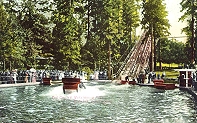
The famed artisan Charles Looff came to Coney Island from Europe in the 1870s and he carved wooden animals that were attached to a circular floor that turned in circles. It opened in 1875 and it was known as a “Carry-Us-All” or carousel. Lamarcus Thompson built the world’s first roller coaster, the Switchback Railroad, in 1884 at Coney Island. Most of the early amusement resorts sprang up near population centers like Coney Island in New York and Ocean Beach near the western edge of San Francisco. One of the earliest parks in the Northwest had beginnings as a baseball park constructed at the end of a cable car line on the Spokane River in Washington. Originally called Ingersoll Park, the baseball field opened on July 18, 1889. In 1893, the Spokane Street Railway, which was owned by the Washington Water Power Company (WWP), bought the entire park and decided to expand it into an amusement park patterned after Coney Island. They built a swimming pool next to the river and set about to rename the park. They stumbled across the Latin word for an indoor swimming pool – natatorium. The new park was christened “Natatorium Park.” |
|||||||||
 |
|||||||||
|
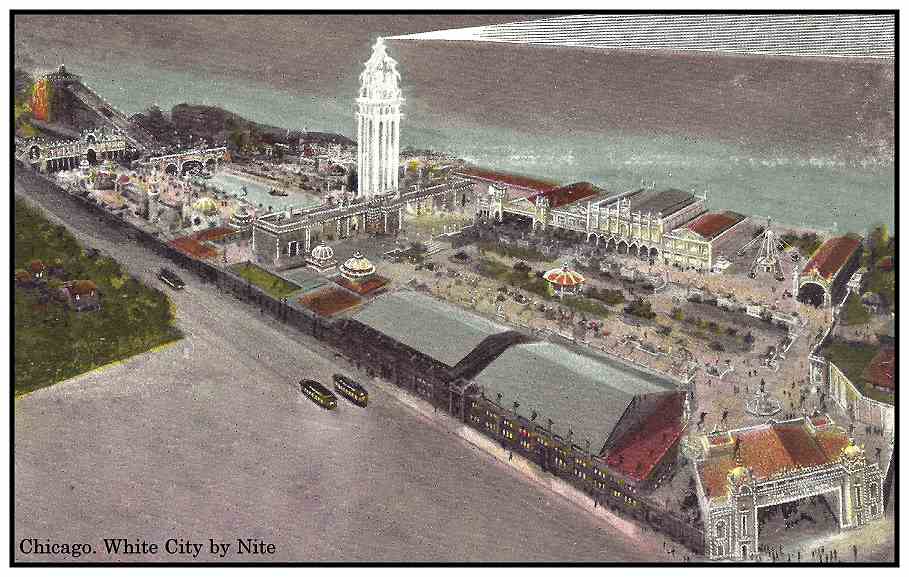
One of the earliest parks, Chicago’s White City, grew out of the World’s Columbian Exposition of 1893. White City was the common name for dozens of amusement parks in the United States, the United Kingdom, and Australia. Inspired by the White City and Midway Plaisance sections of the World's Columbian Exposition, the parks started gaining in popularity in the last few years of the 19th century. The enormously successful World's Columbian Exposition attracted 26 million visitors and featured a section that is now commonly considered the first amusement park: a midway, the mile-long Midway Plaisance, the first Ferris wheel constructed by George Ferris, Thomas Rankin's Snow and Ice Railway, a forerunner of the modern roller coaster, which was later moved to Coney Island as well as lighting and attractions powered by alternating current. Sebastian Ziani de Ferranti had just completed the first power plant with AC power in London only the year before. The Columbian Exposition also featured the debut of several foods that became popular in the United States: the hamburger, shredded wheat, Cracker Jack, Juicy Fruit chewing gum and pancakes made using Aunt Jemima pancake mix. The Zoopraxographical Hall was the first commercial theater. Ragtime music composed and performed by Scott Joplin exposed millions of people to a new form of music and it instantly became a staple for fairs and carnivals. While the Midway Plaisance became the Exposition's main drawing card, it was not the primary purpose of the World's Fair in the eyes of its founders, who pictured it to be the beginning of a classical renaissance featuring electrically-lit white stucco buildings collectively known as White City occupying the main court. While White City gave the park its visual identity, the throngs who attended the Columbian Exposition tended to collect at the Midway Plaisance and Buffalo Bill's Wild West Show, which set up shop just outside the park grounds after the fair's founders rejected Buffalo Bill Cody's attempt to become an official Columbian Exposition exhibitor. Chicago’s Columbian Exposition was destined to be remembered primarily for two ironic visions, that of the crowds at the Midway Plaisance, with exhibitions of boxer John L. Sullivan and exotic dancer Little Egypt as well as its games and its rides, and the architecture of White City. Paul Boyton's Water Chutes, featuring a shoot-the-chutes ride that wasn't present in the Columbian Exposition, was the first amusement ride to charge admission when it opened in 1894. Inspired by the immediate success of his Water Chutes with 500,000 people visiting in its first year of operation, Boyton moved and expanded his Water Chutes in 1896. In 1895, Boyton also opened Sea Lion Park, one of the earliest embodiments of an amusement park, at Coney Island with several rides, including a shoot-the-chutes, an old mill ride and a sea lion show. |
|||||||||
 |
|||||||||
|
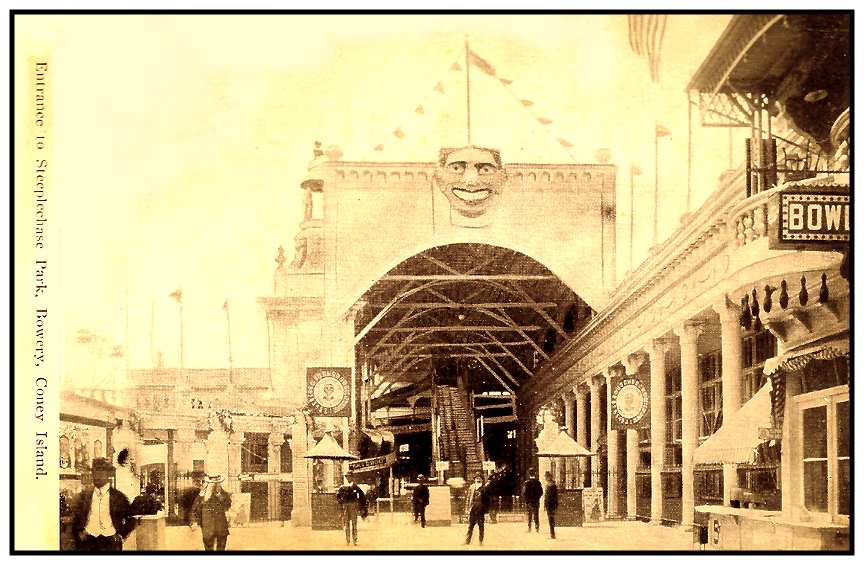
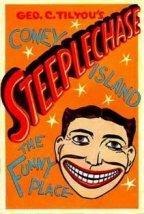
An enterprising man named George Tilyou operated Coney Island’s first Ferris wheel in 1894 at the Bowery, near the Iron Tower, which was built for the Philadelphia Centennial Exposition in 1876 and moved to Coney Island a year later. Tilyou built several other amusements that were scattered around Coney Island. In 1897, he consolidated all of his rides into one place by his Ferris wheel. Tilyou called it Steeplechase Park. In the half decade after the end of the Columbian Exposition, the American concept of the amusement park was starting to take hold. White City amusement parks were making their appearance in Philadelphia in 1898 (it was also known as Chestnut Hill Park) and in Cleveland, Ohio in 1900. An explosion of nearly identical amusement parks soon followed. Parks were being erected at a frenetic pace. A typical White City park featured a shoot-the-chutes and lagoon, a roller coaster (usually a figure eight or a mountain railway), a midway, a Ferris wheel, games, and a pavilion. Some White City parks featured miniature railroads. There were roughly 250 amusement rides operating in the United States in 1899; the number almost tripled to 700 by 1905; and more than doubled again to 1500 by 1919. |
|||||||||
 |
|||||||||
|
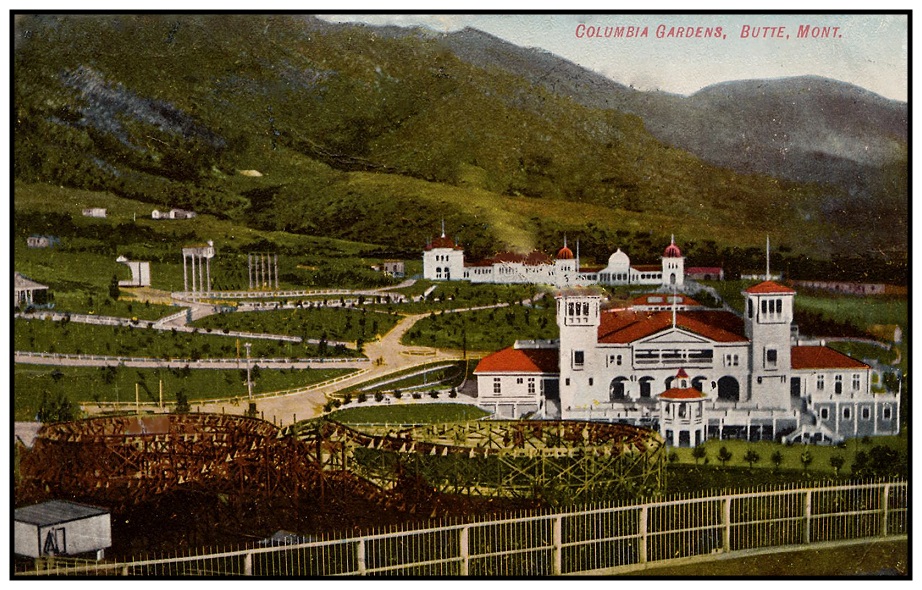
One of the earliest amusement parks in the west, Columbia Gardens, opened in Butte, Montana in 1900. |
|||||||||
 |
|||||||||
|
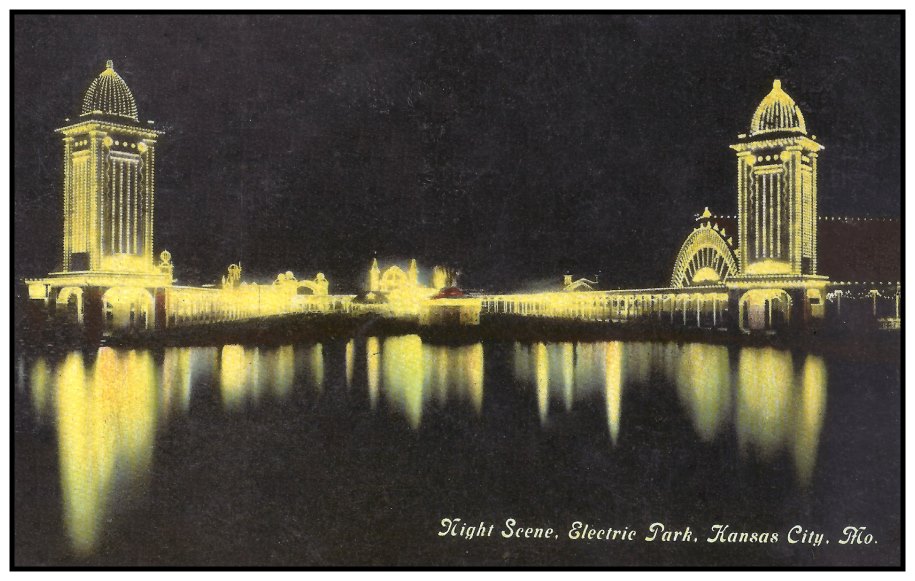
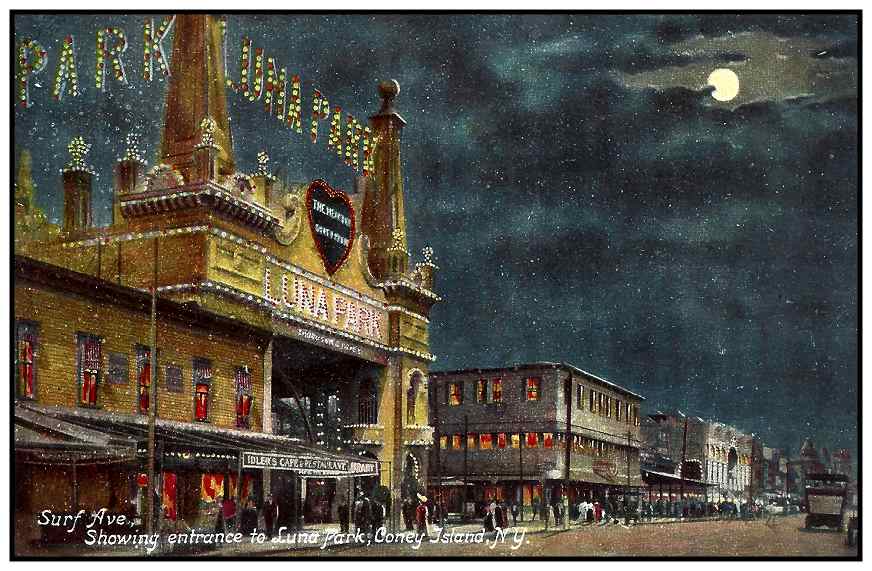
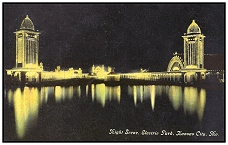
Railway companies, noticing the popularity of Midway Plaisance of the Columbian Exposition and the lack of railroad ridership on the weekends, constructed trolley parks as an effort to improve their bottom line. Power companies were starting to partner with railroad companies to create electric trolley companies and construct “Electric Parks.” Nearly every major city in America had at least one amusement park in the early years of the 20th century. In 1901, partners Frederick Thompson and Elmer Dundy, operated the very popular ride they called "A Trip to the Moon" at the Pan-American Exposition which opened in Buffalo, New York. They also opened a similar ride at Coney Island’s Steeplechase Park. Poor weather and bad economic conditions forced the closure of Sea Lion Park in 1902. Boyton sold Sea Lion Park to Thompson and Dundy who redesigned the park and reopened it as Luna Park in 1903. |
|||||||||
 |
|||||||||
|
The name Luna was derived from the brightly lit green and white cigar-shaped airship “Luna” which transported people on an imaginary Trip to the Moon. The spectacular new park, on the sight of the old Sea Lion Park, featured a forest of towers and spires lit at night by 122,000 electric lights. Luna was probably the most popular park at Coney Island. |
|||||||||
 |
|||||||||
|
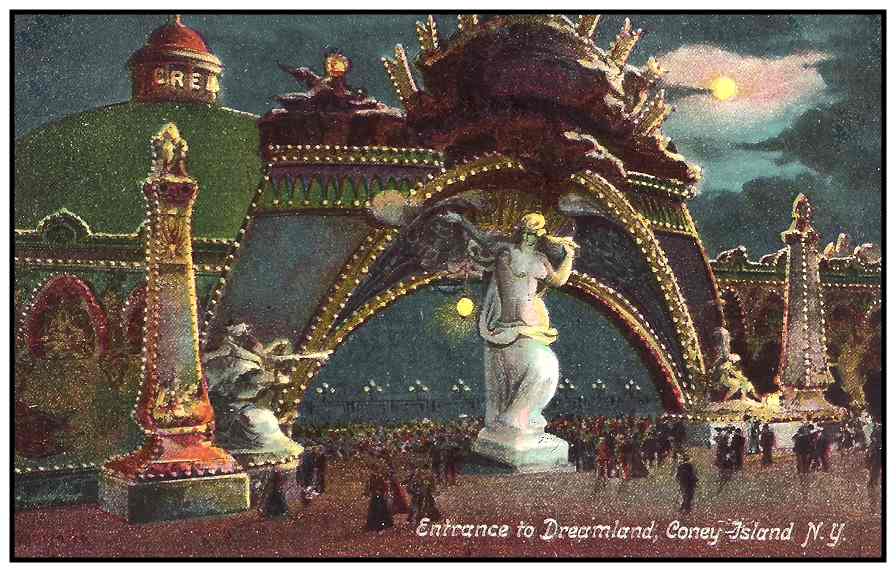
A year later, in 1904, former New York State Senator William Reynolds opened Dreamland to record crowds and his theme was “Bigger and Better”. Whatever Luna built, Dreamland had to build it bigger and better. Where Luna had 250,000 lights, Dreamland had a million. On opening day, 135,000 eager patrons visited the park. |
|||||||||
|
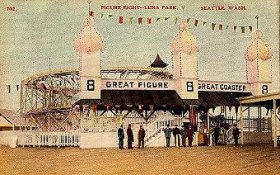
Some long-established parks changed their names to White City upon the addition of amusement rides and a midway. Like their Luna Park and Electric Park cousins, many cities had two (or all three) of the Electric Park/Luna Park/White City triumvirate in their vicinity, with each trying to outdo the others with new attractions. Roller coaster designer and entrepreneur Frederick Ingersoll provided many parks with figure eight roller coasters and scenic railways long before expanding the Luna Park chain in 1905. Over a quarter century period, the Ingersoll Construction Company, erected more than eleven roller coasters per year. The competition was fierce, often driving the electric parks out of business due to increased costs from equipment upgrades, upkeep and increasing insurance costs. Boyton's Water Chutes went out of business in 1908 in the face of increasing competition. More than a few succumbed to fire. |
|||||||||
 |
|||||||||
|
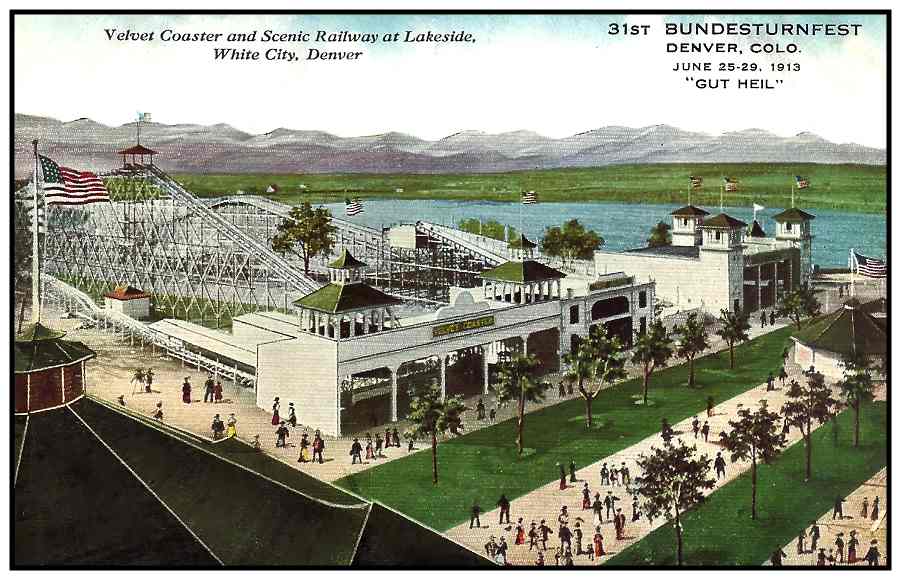
Only one park that was given the White City name continues to operate today: Denver's White City, which opened in 1908, is now known as Lakeside Amusement Park. |
|||||||||
|
In 1900, Portland had 90,000 residents and it was the largest metropolis in the Northwest, Portland had the busiest port up the coast from San Francisco. The Alaska gold rush and the railroads began to make Seattle boom. Portland’s leaders decided a World’s Fair would bring the masses to Portland and they summoned the cutting-edge amusements of the day to come to Portland to help build the Lewis & Clark Exposition. |
|||||||||
 |
|||||||||
|
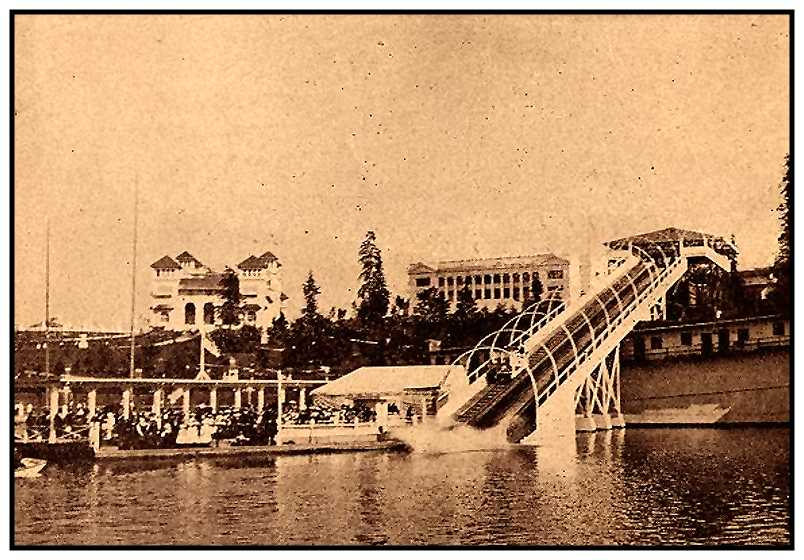
Guild’s Lake provided a perfect location for the popular Chute-the-Chutes at the Lewis & Clark Exposition. Three million people came to Portland’s Party and many of them decided to stay. Portland’s population doubled in the next five years. |
|||||||||
|
|
|
|
Portland’s first amusement park, The Oaks, opened in Sellwood along the Willamette River in 1905. |
|
|
|
A friendly rivalry developed between the builders of Oaks Park and the Lewis & Clark Expo and they had a race to see which could open first. Oaks Park opened two days before the Expo, on Memorial Day, May 30, 1905. In its first season, over 300,000 people packed the streetcars to visit the park and over 30,000 people would visit the park on Sundays and holidays. Oaks Park had a 4000-seat auditorium and The Oaks was said to have been John Philip Sousa’s favorite place to perform, having been there numerous times. The only amusement park in Portland that survives today is Oaks Park, which is the oldest amusement park on the West Coast and the skating rink is the oldest rink west of the Mississippi. |
|
|
 |
|
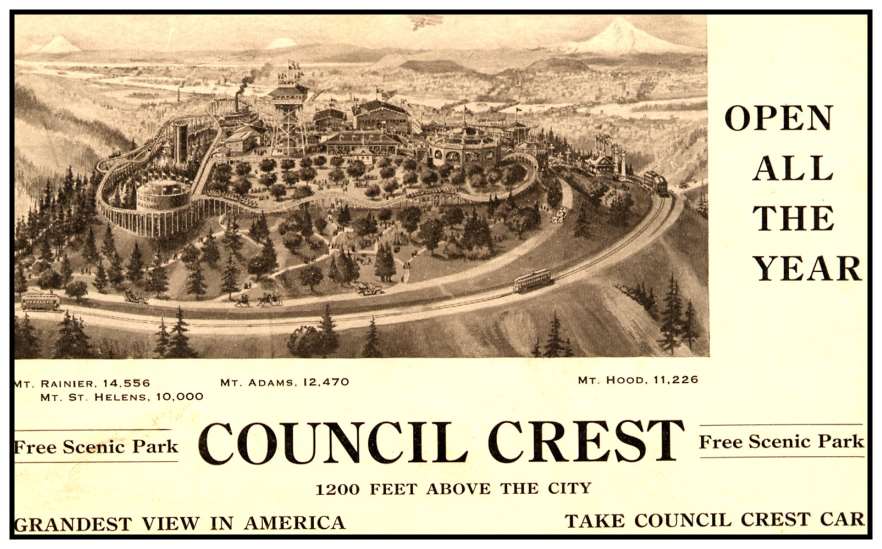
Council Crest, the Dreamland of the Northwest, opened on Memorial Day in 1907. Council Crest’s dance hall at the “Top of the Town” was the place to go on a summer evening. There was a Scenic Railway (roller coaster) and the Columbia River Water Log Ride, which encircled the park. |
|
||
|
|
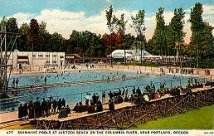
The Portland Railway Light & Power Company conceived of Columbia Beach on Sand Island, (now Tomahawk Island), just to the east of Hayden Island. After several delays, Columbia Beach finally opened on August 5, 1916 after heavy August rains and unusually high water in the Columbia River. Even with the late opening, revenues for the Railway company increased greatly and Portland’s most popular new amusement resort saw many thousands of people. |
|
|
|
Columbia Beach had excellent camping facilities and the dance floor was one of the largest in the country. There were dances seven days a week. There was a miniature railway, a ferris wheel, a merry-go-round, a motordome, a midway, athletic fields, a delicatessen, a grocery store and a roller skating pavilion. According to an ad in the Sunday Oregonian from June 20, 1920, you could ride an airplane for free at Columbia Beach. You could fix a picnic lunch, take the Vancouver Line streetcar to the Park, watch a ballgame and visit the zoo. Then you could dance away the afternoon and night. |
|
||
|
|
Jantzen Beach Amusement Park was heralded as Portland’s “Million Dollar Playground.” When it opened on Memorial Day, May 26, 1928, Jantzen Beach was the largest amusement park in the nation. The park sprawled over 123 acres at Hayden Island at the northern tip of Portland. |
|
There was the huge Dipper roller coaster, the thrill rides, the midway games and midget auto racing. There was also the “Golden-Canopied Ballroom,” which attracted big name bands, and people from all over the world came to compete in the dance competitions, which were complete with orchestras. |
|
|
||
|
|
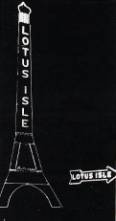
When it opened on June 28, 1930, Lotus Isle was the largest amusement park in Portland on 128 acres. It was located just east of Jantzen Beach at the site of the old Columbia Beach. Lotus Isle was known as the “Wonderland of the Pacific Northwest” and you could take in over 40 rides. |
|
|
|
The Grand Ballroom, which is thought to be the birthplace of the dance marathon circuit, was one of the first locations for the great walkathons where they would pack in 6,000 people and many more lined up outside to get in. Several of the organizers would go on to achieve fame and fortune all over the country. One of them, Leo Seltzer, would go on to start Roller Derby. The ballroom was built at a cost of $60,000 with a wide veranda overhanging a lake. Many unfortunate problems beset the park and it was only open for three seasons. The ballroom caught fire the second season and burned to the ground. Dances were held the final season on the Blue Swan, a barge which was docked on the Columbia River. |
|
||
|
|
Blue Lake Park which is located seven miles east of Portland, near Fairview, opened on July 3, 1925. The photo above from July 3, 1960, shows the Blue Lake Dance Hall and the Merry Mix-Up swing ride. Blue Lake will be remembered for swimming, boating, picnics, concerts, dancing and rides for all ages. The original Dance Pavilion burned in 1928 and it was soon replaced with the building above. Multnomah County took over the park in 1960 and removed all the rides. It is still a popular place for swimming and picnicking. |
|
|
 |
|
|
|
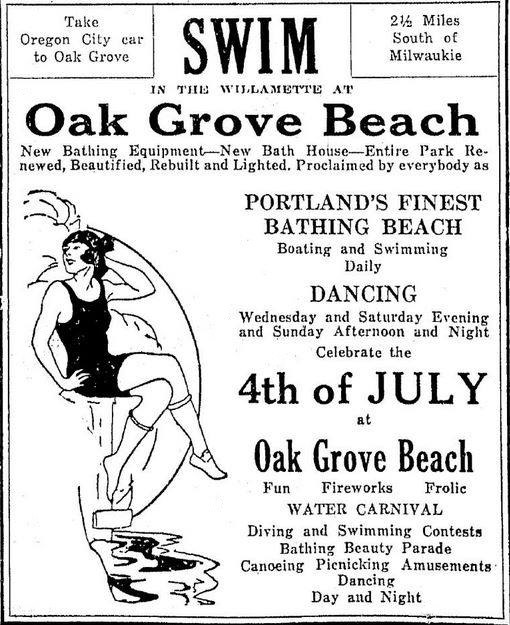
Oak Grove Beach, an amusement resort and park which operated from 1917 to 1929, spread out over 70 acres and it was accessible via the Milwaukie and Oregon City streetcars. Oak Grove Beach was mentioned in the July 1, 1925 edition of the Portland News. The article tells of rides, water chutes, toboggans, floats and high dives that were lit up by floodlights so the park could stay open till 11:00 at night. |
|
|
|
|
|
|
|
|
|
|
|
|
|
|
|
|
|
|
|
|
|
|
|
|
|
|
|
|
|
|
|
|
|
|
|
|
|
|
|
|
|
|
|
|
|
|
|
|
|
|
|
 |
||||||||||||||||||||||||||||||||||||||||||||||||||
|
Source: The Oregonian Newspaper |
||||||||||||||||||||||||||||||||||||||||||||||||||
 |
||||||||||||||||||||||||||||||||||||||||||||||||||
 |
||||||||||||||||||||||||||||||||||||||||||||||||||
 |
||||||||||||||||||||||||||||||||||||||||||||||||||
 |
 |
|||||||||||||||||||||||||||||||||||||||||||||||||
 |
||||||||||||||||||||||||||||||||||||||||||||||||||
 |
||||||||||||||||||||||||||||||||||||||||||||||||||
 |
 |
|||||||||||||||||||||||||||||||||||||||||||||||||
 |
||||||||||||||||||||||||||||||||||||||||||||||||||
 |
||||||||||||||||||||||||||||||||||||||||||||||||||
 |
 |
|||||||||||||||||||||||||||||||||||||||||||||||||
 |
||||||||||||||||||||||||||||||||||||||||||||||||||
 |
||||||||||||||||||||||||||||||||||||||||||||||||||
 |
||||||||||||||||||||||||||||||||||||||||||||||||||
 |
||||||||||||||||||||||||||||||||||||||||||||||||||
 |
||||||||||||||||||||||||||||||||||||||||||||||||||
 |
||||||||||||||||||||||||||||||||||||||||||||||||||
 |
 |
|||||||||||||||||||||||||||||||||||||||||||||||||
 |
||||||||||||||||||||||||||||||||||||||||||||||||||
 |
||||||||||||||||||||||||||||||||||||||||||||||||||
|
Last updated 10-04-17 |
||||||||||||||||||||||||||||||||||||||||||||||||||
 |
||||||||||||||||||||||||||||||||||||||||||||||||||
|
copyright © 2019 PdxHistory.com |
||||||||||||||||||||||||||||||||||||||||||||||||||
| [Portland History] [Site Map] [Amusement Parks] [Oaks Park] [Early Portland] [Department Stores] [Streetcars] [Railroads] [Mt Hood] [Oregon Coast] [Post Card History] [Portland Hotels] [Portland Neighborhoods] [Getaways] [Contact Us] |