
|
|
|
|
||
| [Portland History] [Site Map] [Amusement Parks] [Early Portland] [Department Stores] [Streetcars] [Railroads] [Mt Hood] [Oregon Coast] [Post Card History] [Portland Radio] [Portland Hotels] [Portland Neighborhoods] [Getaways] [Contact Us] |
|
 |
|
||
|
|
|
|
Ralph Eddy and his wife Lillie operated a post card stand during summer months, at “Eddie’s Place” at Wahkeenah Falls along the Columbia River Highway in the 1930s. |
|
|
|
Post cards, as we know them, came into being in 1901. Prior to that time, there were trade cards and postal cards, which usually carried advertising or printed messages. Trade cards became popular with the enterprising merchants who distributed them in the 1870s. With the advent of the camera, which was developed in the mid-1800s, and later the post card, history would be forever immortalized in print. |
|
|
 |
|
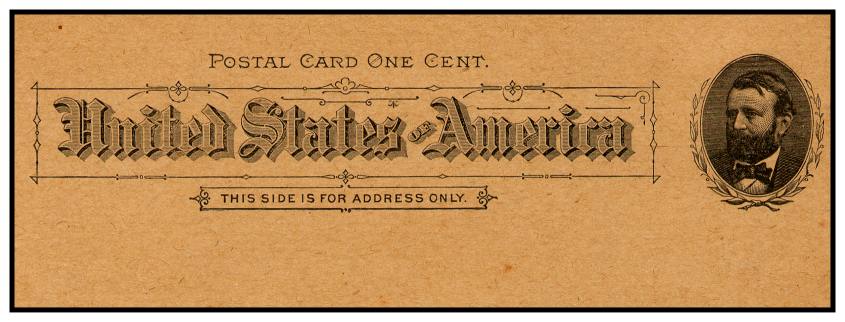
Graphics common on the back of a Postal Card from 1893. |
|
||
|
|
|
|
Souvenir Postal Cards first appeared at the World’s Columbian Exhibition in Chicago on May 1, 1893. Beautiful illustrations of scenes at the Fair were printed on government-printed postal cards and on privately printed souvenir cards. Lines were printed for the message or correspondence. |
|
||
|
|
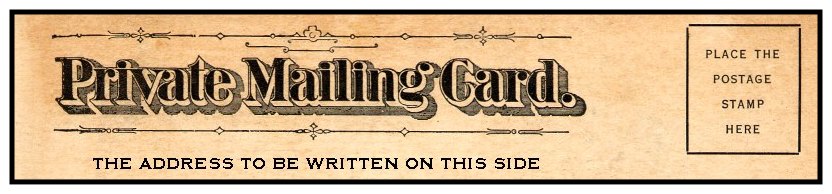
Private Mailing Cards were authorized on May 19, 1898. The back was for the address only. |
|
|
|
|
|
 |
||||
|
Graphics commonly seen on a Private Mailing Card. |
||||
 |
||||
|
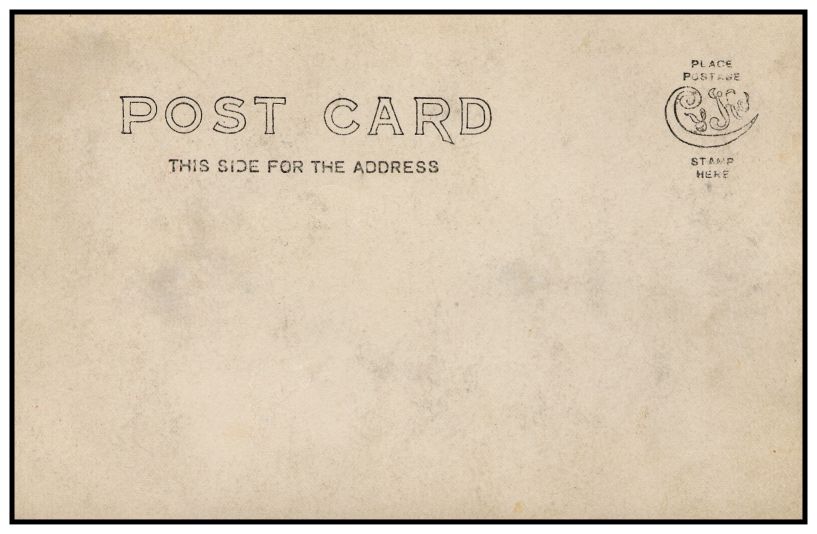
In 1901, the “Undivided Back” post card replaced the Private Mailing Card. Like the Private Mailing Card, the Post Office mandated that the “Undivided Back” could only contain the address, no other writing. On December 24, 1901, the U.S. Government allowed the use of the words “Post Card” to be printed on the undivided back of privately printed cards where the name and address of the recipient were written. They allowed a stamp box in the upper right and they allowed the publishers to drop the authorization inscription previously required by law. |
||||
|
|
|
On March 1, 1907, the age of the “Divided Back”, which contains a section for the address and a section for a note, was ushered in. In 1915, post cards appeared with a “white border” which contains title information. “Linen” cards became dominant in the 1930s and “chromes” first appeared in 1939. There are three basic categories of traditional post cards: real photo, lithographed and special cards which could be made of wood, leather, metal, silk or any other material that could be mailed. Special cards were usually made by hand. “Real photos”, which is a term referring exclusively to postcards, are created by exposing a negative directly onto photographic paper and they provide a quality black and white photographic record of history in the making. They can usually be enlarged somewhat without losing image quality. “Lithographs”, which became popular with the patrons of the Amusement Parks and Expositions; and they were printed in great quantity in Germany. Lithos are known for their sharp images and brightly colored inks. They are still being printed today with an added “chrome” coating. Nearly all of the litho post cards were made from a photograph. The images were enlarged and by using a process known as color separation, the photographic images were converted into many thousands of tiny dots, which were used to shade in the varying colors of ink as they were printed. Most of the post cards were printed in Germany where they developed advanced techniques in color separation and lithography. Many times, hand-drawn cars or pedestrians were added to enhance the excitement. Among the prominent names in Oregon Post Card History were Wesley Andrews, B.B. Bakowski, Arthur Cross, Edward Dimmitt, Ralph Eddy, Benjamin Gifford and Edwin Patton. They lived during the Golden Age of the Post Card, which began in 1901 and lasted until 1918. By 1916, the popularity of the Post Card was on the decline. Oregon’s biggest event happened just as Post Cards began to boom in popularity. The Lewis & Clark Exposition opened in 1905 as Portland took center stage in its own World’s Fair. This event was single-handedly responsible for the production of 450 different post cards. Beautiful European-produced lithographs made up the bulk of these post cards. Also produced at the fair were leather, wood, copper and aluminum post cards. Several Portland post card publishers got their start at the Lewis & Clark Expo: B.B. Rich and D.M. Averill, as well as E.P. Charlton. Lipschuetz & Katz started publishing post cards in the years after the Expo, as did the prolific Portland Post Card Co. which became an official publisher at the Alaska-Yukon-Pacific Expo in Seattle in 1909. When Oregon held its next biggest event in 1959, the Oregon Centennial, thirty different colored chrome post cards were produced and fifteen different black & white photo cards were also produced. Charles Wesley Andrews was born December 10, 1875 in Aurora, Ontario, Canada. He set up his first studio at Baker, Oregon in 1904. He captured many early Oregon views and was perhaps best known for his perfectly framed shots of the beautiful Oregon Coast. For a time, he was publisher of the Morning Democrat. In the 1920s, Wesley Andrews moved his production studios to Portland. Eventually, the business was sold to Herb Goldsmith. Andrews died in Portland on December 22, 1950. Bruno Bakowski was a noted post card photographer from Central Oregon, who was well known for his post cards of scenic Central and Eastern Oregon, stage and freighter wagons and signature city views. His post cards are sequentially numbered and he produced over 3500 views. Bakowski first operated a studio in LaGrande, Oregon in 1908. Over the next three years, he also operated Oregon Art Co., a studio at Bend. His cards were signed either “B.B. Bakowski” or “Oregon Art Co.” On a photo shooting trip to Crater Lake, Bakowski disappeared in 1911 while photographing Crater Lake during a winter blizzard. Search parties found his camp and camera but his body was never recovered. According to the local press, the Medford Mail Tribune, reported search parties were looking for him on Feb. 22, 1911 then on March 1, 1911, the Mail Tribune reported that Bakowski was presumed dead. Arthur B. Cross partnered with Edward L. Dimmitt to sell real photo post cards of the Columbia River Gorge, Mt. Hood and Portland. Cross opened his Electric Studio in Portland in 1909. Dimmitt was born in 1881 in Columbia, Missouri. In 1909, Dimmitt was first listed in the Portland City Directory as a waiter. In 1914, he began working for Cross at the Electric Studio. In 1916, they became partners and named their business “Cross & Dimmitt”. Cross & Dimmitt sold post cards off the running boards of their Model T at Crown Point as the Columbia River Highway was under construction. A set of 20 views, which are fairly common today, sold for $1. Their business grew and they built a post card stand at Crown Point. In the 1920s, they set up a studio at 72nd and Sandy Boulevard in Portland. Cross died August 6, 1940 and Dimmitt died on April 26, 1963 at the age of 82. He had managed the Vista House for 40 years. |
|
|
|
|
||||||||||||||||||||
|
|
|
In 1908, Gifford moved to Portland, selling the studio in The Dalles to his manager, Charles Lamb. He became a contract photographer for the railroads and documented scenes from the Northwest to Yellowstone. In 1920, Benjamin Gifford retired and moved to Salmon Creek, just north of Vancouver, Washington. Gifford’s son, Ralph I., operated the White River Studio on the Mt. Hood Loop Highway on the east side of Government Camp during the 1920s. It was later sold to Forest Ranger and Guide, Ray Filloon. |
|
||
|
|
|
|
Filloon’s White River Studio, circa 1930s. |
|
|
|
Benjamin Gifford died in 1936 at his home near Vancouver, Washington. Ralph Gifford teamed with the State of Oregon’s Highway Division to establish an archive for negatives of photographs that were used to promote Oregon Tourism. Ralph eventually sold the Gifford negatives to Sawyer in the 1940s. Benjamin Clayton Markham was born September 11, 1881. In 1900, at the age of 19, he headed west from Illinois to New Whatcom, Washington, near Bellingham where he was an engineer in a logging camp. His younger brother Ora, who was 18, convinced Ben to quit the logging business and buy two cameras so they could become partners. Ora moved from Peoria, Illinois out to New Whatcom and they started taking picture post cards of the lumberjacks in the logging camps. The Markham brothers moved on to Seattle, then to Portland in December 1903. Ben worked for Woodard Clark Company, one of the largest photo supply houses in the Northwest. Several months later, they split up and went their separate ways. Ben moved to San Francisco and worked at a photo supply house. Ora went to Everett, Tacoma and Spokane, then to Oakland, California before traveling throughout the country. Both Markham brothers moved back to Portland. Ora arrived in 1911, buying the Marcel Studio and building a very successful career as a portrait photographer; and Ben in 1912, where he worked at the Blumauer Photo Supply Company. In 1914, Ben teamed with his boss, Nelson Pike and bought out Blumauer. The Pike & Markham Company operated until 1919 when the partnership was dissolved. Markham became an automotive mechanic for several years. In 1925, Ben moved to The Dalles where he set up a new studio at age 45, in a town dominated by the Gifford Studio. He specialized in photographing Central Oregon farmers, their families and their hired hands. His legendary views of Native Americans in authentic dress are highly sought after today. Markham survived the initial shock of the Great Depression in 1929, but eventually sold his studio to Everett Olmstead on April 14, 1933. Markham retained most of his negatives and moved to Portland again, where he continued to sell post cards. In the next few months, Ben became the Staff Photographer for Olds Wortman and King, one of Portland’s prominent department stores. By 1939, Markham became the manager of Olds and King’s Camera Department and he continued to sell post cards of his work from the 1920’s. On December 25, 1942, B.C. Markham died of a heart attack at his home. |
|
|
|
||
|
|
|
|
Patton’s Post Card Hall in Salem was the largest Post Card Store in the Northwest. |
|
|
|
Edwin Patton hired Eugene Everett Lavalleur as the lead photographer for Patton Post Card Company. Lavalleur held this position from 1911 to 1918 and was probably Oregon’s most prolific postcard photographer. First, he photographed and documented the settlement and development of early Oregon, then he traveled to Washington, Idaho, California and states to the east, photographing all along the way. Lavalleur acquired the post card business from Patton Brothers in 1918 and renamed it Pacific Photo Company. In the 1920s, Lavalleur sold the negatives and equipment to Wesley Andrews who republished many of Lavalleur’s photo cards. Many of these are mistakenly credited as being Wesley Andrew’s work. |
|
||
|
|
|
|
|
|
Eugene Everett Lavalleur (right) enjoys fried chicken as he takes a break from operating the camera. |
|||
|
A.M. (Arthur) Prentiss got his start at Marshfield, Oregon about 1908. His views of shipwrecks have become highly sought after. He soon moved to Portland where was an early photographer for the Union Pacific Railroad. His views of the Columbia River Gorge and the Oregon Coast were published in brochures and other publications. Many of his negatives were used for post cards. Prentiss joined the Weister Company in 1913 as a photographer and secretary-treasurer. In 1917, he partnered with Benjamin Gifford to form Gifford and Prentiss Inc. In 1922, Prentiss acquired Weister’s studio and negative collection. In 1932, Fred Clark, owner of the Angelus Studio purchased Prentiss’ studio from the ailing photographer. The Angelus Studio had been established in Portland in 1911 and they specialized in commercial views such as construction work, building interiors as well as exteriors, machinery, furniture, automobiles and catalog work, etc. After acquiring the Prentiss and Weister negatives, the Angelus Studio renumbered and re-filed the negatives by subject. *Albert Lewis Thomas came to Newport at age 20 from Salem, OR in 1895. He opened a modest curio shop on Beach Street in the Nye Beach area. He was a jeweler by trade and was well known for his agate jewelry, selling both retail and wholesale. He is also known to have published at least 35 different real photo post cards of the Central Oregon Coast. His souvenir book of Newport and Nye Beach views was copyrighted in 1905. He also sold birthday cards, wedding, anniversary, and congratulation cards. He sold agate jewelry, baskets, shells and curios. Thomas probably got his start in photography after a neighboring photo studio went out of business and he purchased the photo and dark room equipment. How much photo experience Thomas had before this is unknown. He quickly set out to take photos up and down the Central Oregon Coast. Thomas’ images today are still striking, and provide an important historic record of Oregon’s ever-changing coastline. To help bring his images to life, Thomas, his wife and other Newport women hand-colored many of his photos. He sold framed and unframed photos, postcards and stereo cards from his gift shop that eventually moved to nearby Coast Street in a building he had built about 1910. He built another gift and photo shop near the north side of the Yaquina Bay bridge in Newport in 1936. He was taking photographs up until his death in 1940. George M. Weister began his photographic career in 1888 with the Partridge Photo Company of Portland. He managed the company until 1893 when he established the Weister-Meek Company. In 1895, Weister established the Weister Company selling photographic supplies, lantern slides and cameras along with his photographic services. His collection of negatives reportedly dated back to 1872. Weister did a lot of scenic photography used by the Union Pacific Railroad. |
|||
|
||
|
|
Cal Calvert with Alvilda Calvert at Oswego, Oregon in 1923. |
|
|
|
Charles Emmett (Cal) Calvert operated his Mazeograph Studio at Sixth & Ankeny from 1906 to 1930. When Council Crest Amusement Park opened, Calvert had a studio and post card stand at Council Crest in 1907. He also operated a studio at the Washington Street entrance to City Park in 1910. |
|
|
|||||||||||||||||||||
|
|
|
Cal Calvert post card backs from the Mazeograph Studios at Sixth & Ankeny and City Park at the Washington Street entrance. |
|
|
|
Cal Calvert’s specialty was fast post cards. The portraits were printed on ready-to-mail Cyko post card paper. Studio backdrops and setups were arranged next to each other in the studio. Presumably the customer would select one and move into position, the photographer would aim the camera, and ten minutes later the patron would have their custom post cards. This studio is well known for it's humorous setup and backdrop of an airplane over Portland which was first used during a Rose Festival celebration. |
|
||
|
|
The airplane over Portland prop was one of Calvert’s most popular backdrops. |
|
||
|
|
|
|
There was also a Calvert’s Studio across the street from the Southern Pacific Depot in Oregon City, it was run by Harry Calvert (no relation to Cal) and his wife Alvilda. They were friends of Cal who taught the photography business to Harry. The studio operated from 1915 to 1930. Harry died in 1938. |
|
|
 |
|
|
|
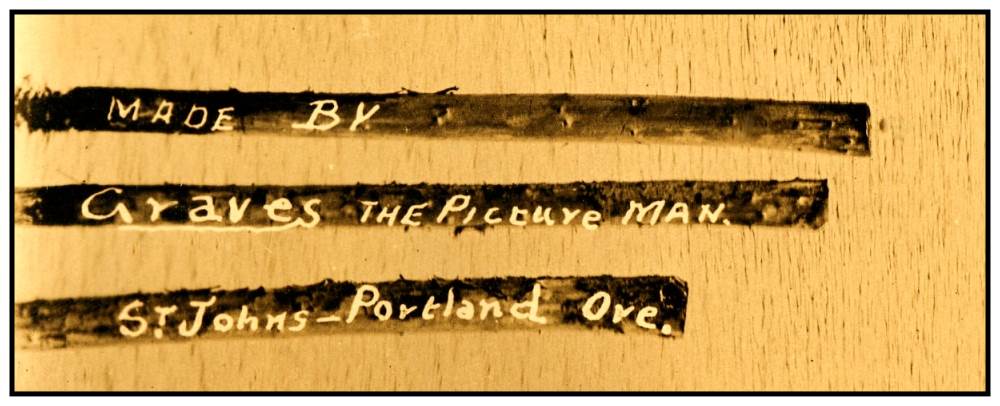
“Graves The Picture Man” operated out of St. John’s about 1920. This signature, which was written on the negative, appears on three upright piers on the dock at Bay City, Oregon. He also took photos in Pendleton which have a similar signature. It is presumed that “Graves The Picture Man” was Harold Graves who joined the Sawyer Studio in 1926. Photo courtesy of David Anderson. |
|
|
|
|
 |
|||
|
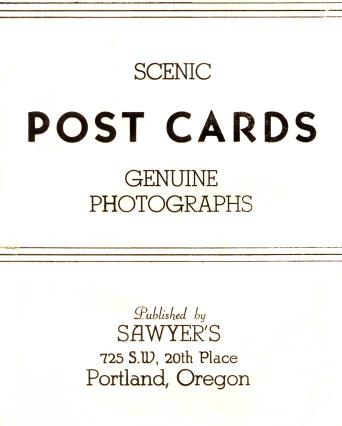
Carlton Sawyer established a studio in Portland in 1911 where he produced his famous “Sawyer’s Scenic Photos” until 1917. In 1918, brothers Fred and Ed Mayer bought part of Sawyer's. In 1926, Harold Graves joined Sawyer's and was responsible for Sawyer's producing photographic postcards and album sets as souvenirs. Later, photographic greeting-cards were added to the product line and sold to major department stores. |
|||
|
Wilhelm Gruber, a piano tuner, organ builder and photographer, lived in Portland, Oregon. While vacationing at the Oregon Caves National Monument in Josephine County, Oregon, he met the President of Portland's Sawyer's Inc, a picture postcard and film developing company, Harold Graves. Gruber made a stereo imaging rig from two Kodak Bantam Specials mounted on a tripod. He had the idea of updating the old-fashioned stereoscope by using the new Kodachrome 16 mm color film. Shortly thereafter, in 1939, Gruber and Graves formed a partnership which led to the retail sales of View-Master viewers and reels. The patent on the viewing device was issued in 1940, on the Model A viewer. In late 1939, the View-Master was introduced at the New York World's Fair (marked "Patent Applied For"). It was intended as an alternative to the scenic postcard, and was originally sold at photography shops, stationery stores, and scenic-attraction gift shops. In the 1940s, the United States military recognized the potential for using View-Master products for personnel training, purchasing 100,000 viewers and nearly six million reels from 1942 to the end of World War II in 1945. With sales of View-Masters increasing rapidly, they soon absorbed the declining postcard business at Sawyer's. In 1950, they built a View-Master factory in Beaverton, Oregon. The Sawyer Company has changed hands over the years, it was purchased by GAF (General Aniline and Film) Corporation in 1966 and again in 1981 by a group headed by Arnold Thaler, head of Ekco Housewares. In August 1989, the View-Master product line was sold to Tyco Toys Inc. When Mattel merged with Tyco in 1997, the View-Master line shifted to Fisher-Price. View-Masters are still sold today. |
|||
|
|
|
Smith’s Scenic Views began producing post cards in the 1930s in Salem. They still have operations in Portland and Tacoma. Seaside was home to several notable photographers beginning with William J. Montag in 1909. The Montag Studio changed hands over the years. It was operated by Leslie Hale in the 1930s and 1940s. A listing in the Seaside Telephone Directory for 1951 gives “John Boyer – Montag Film Shop and Studio at 107 Prom – Phone 433”. (Information provided by Clatsop County Historian David Elston.) Pope Photo Studio was known to have produced post cards of Seaside and Hillsboro. J. Waterhouse operated out of Seaside beginning about 1910 and lasted a couple years or so. He produced many classic postcard views of Astoria, Seaside and Clatsop County. |
|
||
|
|
|
|
Thomas R. Monk operated a studio in Tillamook about 1920 and he produced many postcards that are labeled “Aus Photos”. He made a number of postcards featuring Bayocean that are imprinted “Monk’s Studio - Tillamook, Ore.” on the back. |
|
|
|
Other early Oregon photographers included Archibald of Bridal Veil. Robert L. Ball established the Ball Studio in Corvallis in 1912 and he was known for his many views of the Central Oregon Coast. Thomas Charles Bell, who was responsible for many coastal views operated studios at Astoria from 1901 to 1907 and in Lebanon from 1911 to 1913. In 1915, he moved to Junction City and in 1917, he moved his studio to Toledo. Bonney Photo Studio operated for several years in Estacada beginning in 1908. Operating individually, F.E. Boner and E.F. Surface also published post cards in Estacada about the same time. There was Elmer Allen Coe of Astoria, who became a mentor to the prolific Frank Woodfield who had a studio in Astoria from 1903 to 1942, there was H.R. (Herbert) Gregg who operated out of Bay City from 1909 to 1913. There was Laidlaw from Bend. Madras based O. Hedlund began operating in 1910 and he concentrated on Central Oregon. Charles S. Reeves of White Salmon, Washington produced post cards of Mt. Hood and the Columbia River Gorge from 1910 into the 1920s. He photographed many scenes in Oregon and Washington. His negatives were acquired by Wesley Andrews. He was living in Crescent City, California in 1930. In the early 1930s, Andrews was reproducing cards from Reeves’ negatives. J.H.C. Sorenson of Gresham made many early post cards of East County from 1909 to 1911. Franklyn S. Sowell, “The Photograph Man who Made Pictures Anywhere, of Anything At Any Time”, had a studio in downtown Portland from 1911 to 1915. He had a studio at Oaks Park for a time as well. There were many other post card photographers. Also, many more anonymously produced cards or “privately done” RPPCs were also made. |
|
||
|
|
|
|
Clarence Christian was another prolific Northwest photographer in the 1940s and 1950s. Christian and his partner, Robert Lane had a studio at 2818 NE 31st Avenue in Portland. |
|
|
|
Research for part of this information comes from studying Thomas Robinson’s “Oregon Photographers: Biographical History and Directory 1852-1917” (published 1993) and from Edwin D. Culp’s article on post card photographers in Oregon in the Oregon Historical Society Quarterly (Dec. 1965). I would also like to give a word of thanks to Stephen Kenney, Jr. for providing some of the missing information. *Thanks to Jodi Wheeler, Museum Archivist at the Lincoln County Historical Society for providing information about A.L Thomas of Newport. |
|
|
|
|
|
|
|
|
 |
|||||||
|
American Post Card Eras
|
|||||||
|
Last updated 02-17-18 |
|||||||
 |
|||||||
|
copyright © 2019 PdxHistory.com |
|||||||
| [Portland History] [Site Map] [Amusement Parks] [Early Portland] [Department Stores] [Streetcars] [Railroads] [Mt Hood] [Oregon Coast] [Post Card History] [Portland Radio] [Portland Hotels] [Portland Neighborhoods] [Getaways] [Contact Us] |