
|
|
|
|
||
| [Portland History] [Site Map] [Amusement Parks] [Early Portland] [Department Stores] [Streetcars] [Railroads] [Mt Hood] [Oregon Coast] [Post Card History] [Portland Hotels] [Portland Neighborhoods] [Bull Run] [Getaways] [Contact Us] |
|
Portland Neighborhoods |
|
||
|
|
|
|
Portland’s roots can be traced to its neighborhoods and surrounding communities. As each settlement or town was established, a Post Office would be built there and cancellation stamps were issued to identify the sending post office. For a few years, around the beginning of the 20th century, the sending and the receiving post offices would each stamp a cancellation on every piece of mail. Most of these towns grew up along the streetcar and rail lines. Towns such as Bull Run and Estacada were built so the workers who built and maintained the power generating facilities could live near the dams and power houses. Sellwood had a large blue-collar district; it was home to several mills and manufacturing plants as well as the Sellwood Car Barn where Portland’s Interurban Streetcars were housed and maintained. Agricultural enterprises were plentiful in Gresham. There were many berry growers, fruit and vegetable truck gardeners, nut farmers and nurserymen. There were dairymen and cattle ranchers as well. They utilized the streetcars and later freight trains to ship their goods and bring them their fertilizer, feed and supplies. St. Johns was site of many manufacturing plants and mills. There was easy access for marine traffic and exceptional railroad facilities. Kenton’s Rail Yards helped to make the town an industrial area. It became even more famous as Cowtown when Swift Packing Company set up shop opposite Hayden Island on the Columbia Slough in 1909. Swift employed over 600 workers and they butchered more beef in Kenton than in any other town in the Northwest. When the cattlemen brought their herd to market, they lived it up in Kenton. |
|
||
|
|
|
|
Once upon a time, in 1843, Tennesee drifter, William Overton and Boston lawyer, Asa Lovejoy were floating down the Willamette River in a canoe when they came upon the beauty of the place we now call Portland. They beached their canoe at “the Clearing” and they marveled at the beautiful mountains with the rich potential of the many trees. Overton didn’t have the quarter to file a land claim, so he sold half of his 640-acre site to Lovejoy for 25 cents. They began to clear the many trees, build roads and build the first buildings. After a while, Overton decided to move on and sold his half of the share to Francis Pettygrove. Portland got its name when Asa Lovejoy and Francis Pettygrove flipped a coin in 1845. Lovejoy was from Massachusetts and wanted to name the new settlement Boston. Pettygrove was from Maine and wanted to name it Portland. Pettygrove won the coin toss two out of three times and the rest as they say is history. Portland’s first Post Office opened in 1849, and the steam sawmill’s whistle could be heard at Fort Vancouver. By 1850, about 800 residents made their home in Portland, there was a log-cabin hotel and a newspaper, the Weekly Oregonian. Portland was incorporated in 1851 and it has grown into the second largest city in the Northwest. People who settled in this region made their living from fish, lumber, wheat and cattle, and Portland became a major transportation center because of its proximity to Railroads and Rivers. Portland existed in the shadow of Oregon City, the territorial capital of the Oregon Territory, which was 12 miles upstream on the falls of the Willamette River. Oregon City was laid out and named by Dr. John McLoughlin in 1842 and he would later become the Father of Oregon. McLoughlin was hired by the Hudson’s Bay Company to establish Fort Vancouver, a fur trading outpost on the Columbia River. The outpost, which was established in 1825, served as the headquarters of the Hudson’s Bay Company in the Oregon Territory. |
|
||
|
|
|
|
Snow in Sellwood in 1909 |
|
|
|
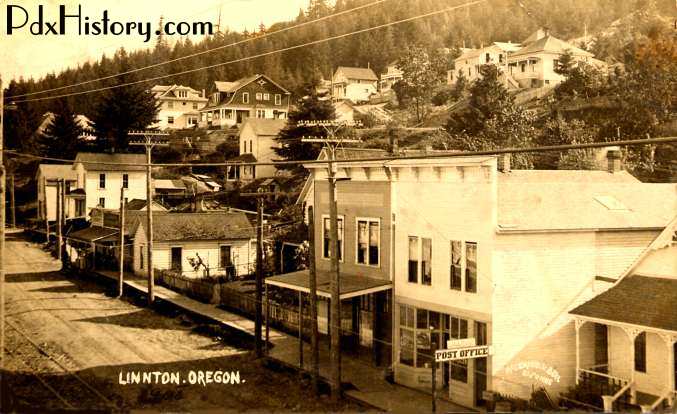
Portland also triumphed over early rivals like Milwaukie and Sellwood. Milwaukie was founded by Lot Whitcomb in 1847 as a rival to Oregon City. Sellwood was named for the Reverend John Sellwood in 1882 and a post office was established there in October 1883. Sellwood became part of Portland in 1893. There were numerous platted additions with fancy names like: Council Crest, Hawthorne, Hyde Park, Irvington, Ladd’s Addition and Mount Tabor. Many of these additions had come into being before Portland had become a metropolis and many of them had their own post offices. Linnton was laid out in 1843 by pioneers Peter Burnett (the first governor of California) and M.M. McCarver. Linnton had a post office from 1889 to 1936. James John, who had crossed the plains to California in 1841 with General Bidwell, came to Oregon in 1843. Settling first in Linnton, John moved to the site of the town that bears his name soon thereafter. He operated a ferry there in 1852. A plat for Saint Johns was filed July 20, 1865. It was annexed to Portland in 1915. A post office operated in St. Johns from 1873 to 1912. A post office was established at Portsmouth, southeast of St. Johns on April 17, 1891. Several months later, on August 25, 1891, the Portsmouth Post Office closed and moved to nearby University Park, where a plat for the town was filed in April 1891. The University Park Post Office operated until November 14, 1903. |
|
||
|
|
|
|
The Portland Woolen Mills had originally been located at Sellwood, but after a disastrous fire in February 1904, they moved to St. Johns and built a new plant |
|
|
 |
|
|
|
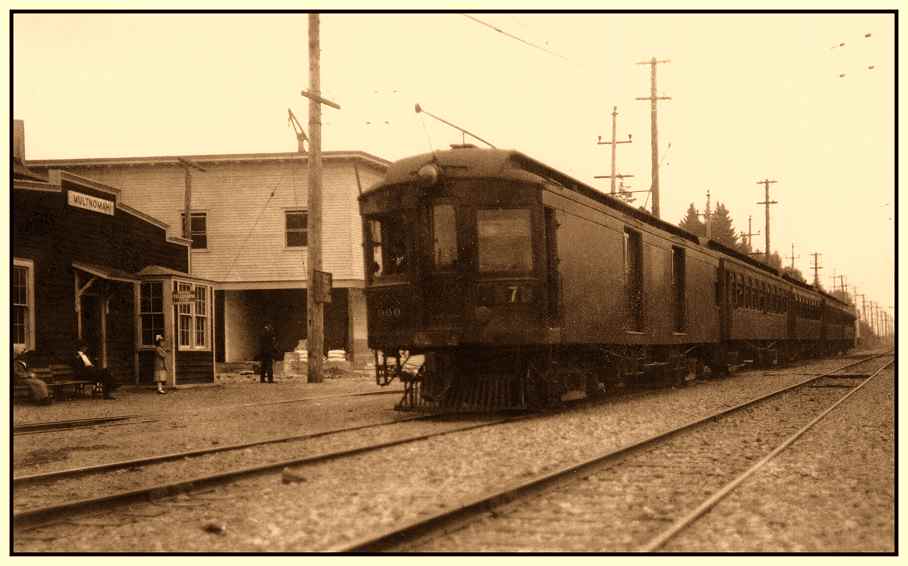
The town of Multnomah in Portland’s Southwest Hills got its name from the Oregon Electric’s Multnomah Station which was built in 1907 at what is now 35th and Multnomah Boulevard. A post office opened in Multnomah in 1912. Other surrounding towns and neighborhoods in the Southwest Hills included Burlingame, Capitol Hill, Fulton Park and Hillsdale. |
|
|
 |
|
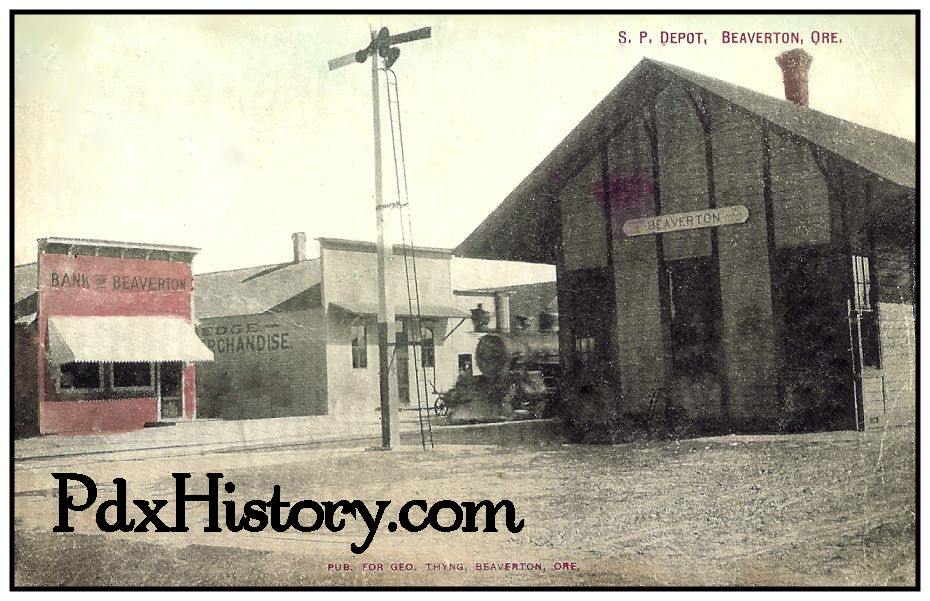
Further to the west, in the spring of 1847, the first land claim (comprising 640 acres of Beaverdam) located in what is now Beaverton was taken up by Lawrence Hall. |
|
|
|
West of Beaverton, in the area now known as Hillsboro, the European-American community was founded by David Hill, Isaiah Kelsey, and Richard Williams, who arrived in the Tualatin Valley in 1841, followed by six more pioneers in 1842. The locality went by two other names €”East Tualatin Plains” and “Columbia€ ”before it was named "Hillsborough" in February 1850 in honor of Hill, when he sold part of his land claim to the county.
Oliver P. Lent of Ohio arrived with his wife in 1852 and they settled at a small community east of Portland called Sycamore. In 1866, they moved a little to the west to a tract of 190 acres which is the current site of the community of Lents, Oregon. A post office was established at Lents in 1886 and it operated until 1917. Oliver Lent built and operated a sawmill for many years. He served as school director, road supervisor and justice of the peace. A separate community of East Portland was established early on, having had a post office from 1866 to 1892. Albina was laid out in 1872 and it was incorporated in 1887. Albina had a post office from 1876 to 1892. An election was held on June 1, 1891 on a successful proposal to combine Portland, East Portland and Albina. Portland’s first electric streetcar took to the rails in 1889 and it carried passengers across the Steel Bridge to the town of Albina. Shortly thereafter, Portland’s first and only cable car began taking passengers up to Portland Heights. |
|
||
|
|
|
|
Woodstock Car 708 is stopped at 46th and Woodstock Streets. The line came east on Hawthorne to 11th where it turned south to Clinton Street. The line followed Clinton to 26th Street where it meandered south to Gladstone Street and south on 42nd Street to Woodstock. The line terminated at 57th and Woodstock Streets. |
|
|
|
Woodstock bears the name of a real estate tract platted in 1889. At that time it was in vogue to name housing tracts after Sir Walter Scott's novels. In the Southeast part of Portland we have Woodstock, Ivanhoe, Kenilworth and Waverly (spelling is different from Waverleigh). The word "stoc" is an Anglo-Saxon word which means a stockaded place and woodstock means a place fortified with wooden posts. Woodstock had a post office, as a separate town, with its own postmark, beginning in 1891 and it lasted until 1912. The town of Kenton, Oregon was platted by George F. Heusner in 1905. He envisioned an industrial community on the North end of Portland. Originally, he wanted to name the town Kenwood, but another addition to the city was already using the name, so he settled on Kenton. Portland’s Hollywood district started taking shape along Sandy Road around 1900. It was originally called Hollyrood. In 1926, after the Hollywood Theatre opened, the area was renamed Hollywood. You can’t talk about Portland history without talking about Bull Run, the source for Portland’s pure drinking water. Located in the western foothills of Mt. Hood, Bull Run was also a main source of electricity for Portland and in the early days, it boasted a town that had a Hotel, Gas Station, Grocery Store, Blacksmith and many other amenities that a modern town of the turn-of-the-century boasted of. It is believed that the original settlement, which was christened Unavilla, was near to the present-day location of the Bull Run School. A post office was established there on May 6, 1893. This was about the time the pristine waters of the Bull Run Watershed were harnessed. An elaborate water purification and delivery system was built to transport this water to the residents of Portland and the surrounding area. Within a couple years, Bull Run outgrew Unavilla and the post office moved about a mile east to Bull Run on Nov. 22, 1895. There are plateaus above the Bull Run River, on the way to Marmot, where wild cattle ran free, hence the name “Bull Run”. The bulls had probably escaped from pioneers who came in Wagon Trains from the East on The Oregon Trail. |
|
||
|
|
Early view of Main Street in Bull Run paved with wood planks |
|
|
|
Damascus is a small community southeast of Portland, at the end of Foster Road, nine miles from 82nd Avenue. Its first settlers moved there in the 1850’s. Edward Pedigo, a potter who moved there from Iowa in 1854 is credited with thinking of the name Damascus. He was drawn to the rich red clay on the hills above the Clackamas River that would make his bean pots and jars famous. The year was 1866, and a group of locals had gathered at the crossroads store to find a suitable name for their school and post office. The battles of the civil war were still within memory and as Ed Pedigo came riding in on his horse, he was struck by the phrase “The Place of a New Beginning”. Pedigo’s thoughts had reminded him of Saul of Tarsus who had set out on a journey from Jerusalem. As Saul approached the walls of Damascus in Syria, he was transformed after meeting the Savior. Pedigo the Potter suggested they name their town after Damascus. All the locals agreed and so did Uncle Sam, as the Damascus Post Office was established on Aug. 26, 1867. |
|
|
 |
|
|
|
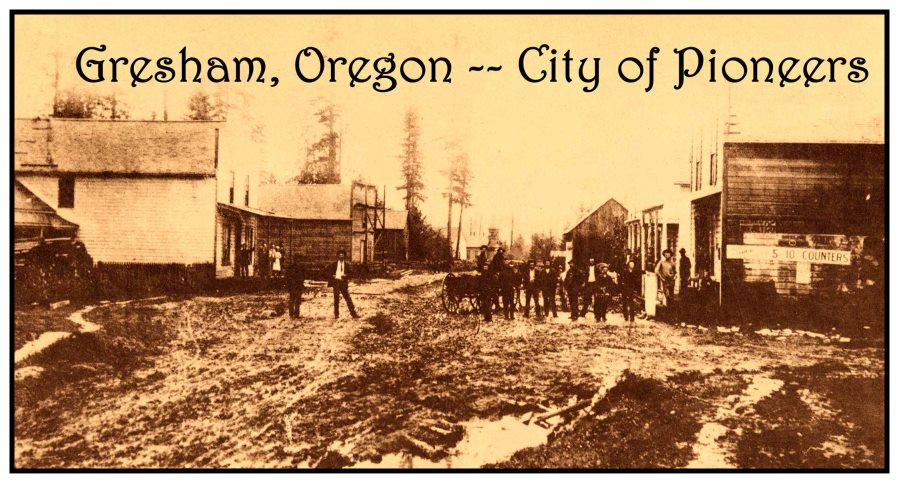
Gresham, Oregon , circa 1885. |
|
|
|
The town that we know of today as Gresham was first settled in the mid-1800s by pioneer settlers James and Jackson Powell who moved to Oregon from the Midwest in 1852. The area became known as Powell’s Valley. Powell Valley School was established in 1857. In the 1870s, a religious camp meeting ground was established in the area and this became a popular stop-off point for people traveling to Portland. The first post office was established here on July 12, 1871 and it was called Camp Ground. The first sawmill was built here in 1880 and the first church was established in 1884. At that time, a local merchant petitioned the U.S. Post Office Department to open a new post office in his store and he requested that it be named after the Postmaster General: Walter Quentin Gresham, a former Colonel in the Union Army. His request was granted and the new post office opened on May 15, 1884. The Camp Ground post office subsequently closed on June 9, 1884. Officials in Portland saw a need for supplying fresh water to its residents. An elaborate water purification and delivery system was built through Gresham to transport water from the Bull Run Watershed to the residents of Portland and the surrounding areas in 1893. The first telephone line was installed in Gresham in 1894 and the first road to Gresham, Baseline Road, opened in 1895. |
|
||
|
|
Estacada Park was built to attract throngs of streetcar-riding city dwellers to this amusement resort in the mountain foothills |
|
|
|
Estacada is a community that was planned around the generation of electricity for Portland and surrounding communities. A post office was established at Estacada on February 24, 1904 and the town was incorporated in 1905. With several sawmills, Estacada has had a long history as a timber town. |
|
|
 |
|
|
|
|
|
|
|
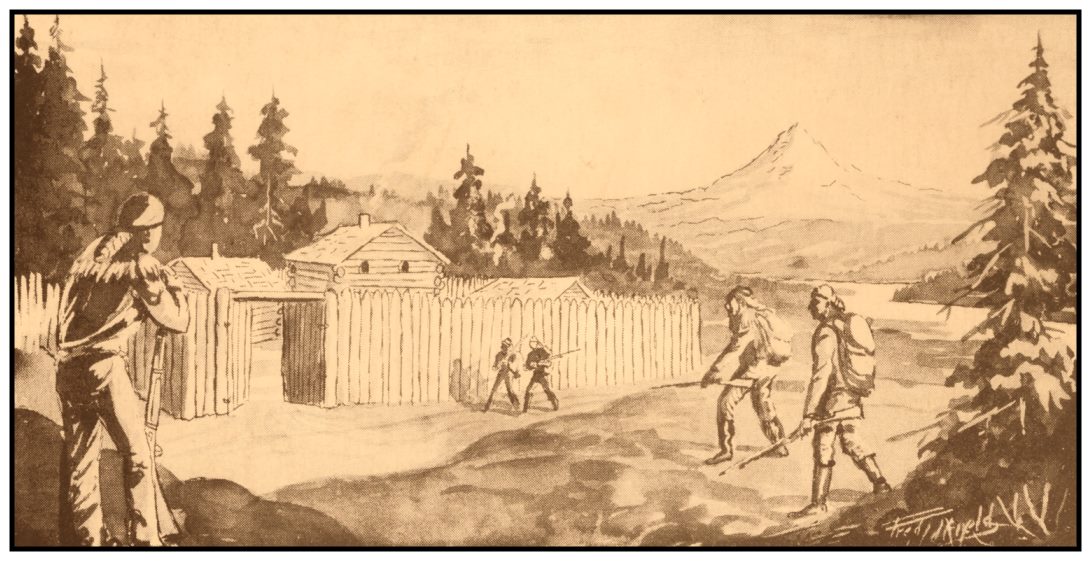
Fort Vancouver was established by the British-owned Hudson’s Bay Company in 1824 on the north shore of the Columbia River, near the confluence of Oregon’s Willamette River. It was the outpost for the Oregon Territory which stretched from California to Alaska, from the Pacific Ocean to the Rocky Mountains. |
|||||
|
The city of Vancouver was named after Captain George Vancouver (1757–1798) a British officer of the Royal Navy, best known for his 1791 to 1795 expedition, which explored and charted North America's northwestern Pacific Coast regions, including the coasts of contemporary British Columbia, Canada and Alaska, Washington and Oregon. He also explored the Hawaiian Islands and the southwest coast of Australia. |
|||||
|
Last updated 01-28-19 |
|||||
|
copyright © 2019 PdxHistory.com |
|||||
| [Portland History] [Site Map] [Amusement Parks] [Early Portland] [Department Stores] [Streetcars] [Railroads] [Mt Hood] [Oregon Coast] [Post Card History] [Portland Hotels] [Portland Neighborhoods] [Bull Run] [Getaways] [Contact Us] |